GAMEPLAY:
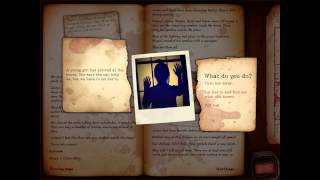
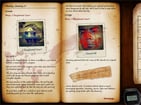
"Zafehouse: Diaries" (ZD) is a unique game about five ordinary people (called "survivors") struggling to escape a city that has been overrun by zombies. Gameplay is turn-based, with each turn representing one hour in the in-game world. In each turn, you can give each of the five survivors one task. A wide variety of tasks is available: moving across the map, inspecting another building, trying to break in, patrolling for zombies, searching the current location, searching and removing killed zombies, standing watch, sniping zombies from inside, cooking food, enhancing the equipment, treating wounded team mates, barricading a location, creating a distraction, etc. Each survivor can move and act individually, but it's also possible to let them work together on the same task. At the beginning of each turn, the results of the previous tasks show up as detailed descriptions in the group's "diary".
The goal of ZD is to obtain information about the arrival time, location, and contact frequency of the evacuation helicopter that's their last chance of escape. This information is contained in small notes dispersed over several locations. You are therefore sending your survivors out to search the buildings of the city. Most of those are houses or shops, but there are also a several special buildings like a police station, hospital, or school. These buildings often offer unique loot, or the ability to perform special tasks not available elsewhere - however, they are also often full of zombies. In general, zombies are scarce in the beginning, but their numbers will grow considerably over time. You can partially avoid them by foregoing tasks that make noise (but that won't always be possible) or by creating a distraction elsewhere (but that might be dangerous for the person who has to do it).
ZD contains a lot of different items: weapons ranging from knives to submachine guns, various types of ammunition, food, and tools of all kinds (which can improve the results when performing a matching task). Most items are multifunctional - a fire axe is useful for breaking in, but also for fighting zombies.
ZD keeps a special focus on the relations between your survivors. How well people get along with each other determines how well they work together, but it can also trigger serious fights. Managing the relations of the group - through planting rumors, letting people work together, or separating them if necessary - is an integral part of ZD, and something which sets it apart from many other games.
ZD also contains several random events, which may require difficult decisions, and can have drastic consequences.
The game doesn't have a real "story" beyond the things already mentioned, but it's nevertheless a tense and gripping experience. It does a great job in capturing the feeling of other "ordinary people in a zombie apocalypse" stories.
GRAPHICS:
ZD plays in a fixed resolution of 1024x768. The graphics are simple and crude, but they do match the setting and the general atmosphere. The entire game takes place on only four screens:
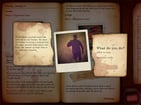
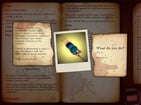
- the diary, which contains a lot of text, and the occasional picture of a house, person, or item
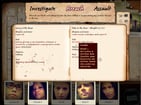
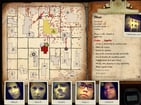
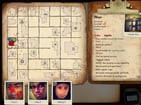
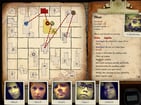
- a very abstract, hand-drawn, blocky, single-color city map on which you move the survivors
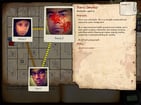
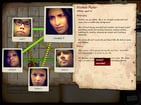
- a screen that shows the relations of the survivors to each other, and gives some information about their background, skills, and personality
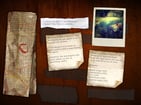
- a screen that shows all all information about the evacuation that you have collected so far
Altogether, ZD offers just enough visual stimulation to trigger your own imagination.
SOUND:
When a new entry is added to the diary, ZD plays an appropriate sound clip - shattering glass, moaning zombies, gunshots, etc. Since there aren't many different sound clips available, this gets repetitive quickly, though it's nice that ZD isn't completely quiet.
There is no music (apart from a short tune in the main menu) and no voice acting.
INTERFACE:
The interface takes a bit of getting used to, it's not immediately clear which elements are clickable. Inventory management can be a chore even though ZD uses a "group inventory" concept: Instead of having to handle each survivor's inventory individually, they will automatically take any appropriate item for the task that has been assigned to them, so you only have to manage the inventory when your group is relocating. However, this may still happen dozens of times in each playthrough.
The interface also leaves many things unexplained, which then have to be figured out by the player through trial and error. This is not necessarily a bad thing - arguably, the insecurity and the lack of information do contribute to the tight atmosphere. However, sometimes it just makes no sense to have no information. For example, the characters ought to know whether their carrying capacity keeps changing due to fatigue, nutrition levels, or injuries, but the player has no access to that information - he just notices the capacity fluctuating wildly.
ZD is entirely played with the mouse.
Task switching is supported, but you may need to switch your desktop resolution to 1024x768 if you want ZD to fill the screen.
EASE OF USE:
ZD installs without any hassles. Be sure to use the automatic update function, or to check the developer's site for the latest patch, as ZD has been expanded and enhanced considerably over time. The manual is not included in the download, I got mine from the developer's site.
ZD can be saved at any time, but you have only one save slot, and the savegame will be deleted after reloading it. This adds to the tense atmosphere of ZD.
OTHER THINGS OF NOTE:
A single playthrough might take about 2 hours, but it hugely depends on your playing style and speed. ZD has a lot of replay value due to the randomization of the locations and the items found there, as well as the survivors and their skills, personalities, and relations. You can never rely on a certain skill to be present in your group, or on a certain building to be present in a city, so you have to adapt your strategy in each game. There is also an alternative game mode available, in which the goal is to repair a car and escape in that. However, after about a dozen playthroughs, ZD feels a bit schematic (especially in the way how the relations between the survivors are managed), and the feeling of guiding actual people through a zombie apocalypse is replaced by a feeling of juggling certain variables in order to win ZD. Also, the descriptions in the diary do become repetitive. More and varied descriptions of actual, meaningful interactions between the survivors would have been great.
ZD is pretty hard to win, but that's not a problem for a rather short game with a high replayability factor. One important hint about a non-obvious gameplay peculiarity: _If_ a location contains a note about the evacuation, then you will find it within the first hour of searching, so there's no reason to keep searching there unless you're interested in the items you may find.
ZD is DRM free, which is always nice.
ZD is quite open to modding. It even includes an editor in which you can create your own survivors (complete with pictures, skills, and personal background) as well as your own buildings. You can easily mod ZD to be about yourself and 4 friends, in your home city.
CONCLUSION:
ZD is original, tense, and gripping - definitely recommended unless you insist on snazzy graphics.
Review Date: 2013/Apr/28 -- Program version: 1.1.82 -- Progress: about 10 games, one won